Ride envelope first
Passenger eye points, the swept motion envelope, emergency positions and rescue paths establish the no-conflict volume.
Immersive attraction systems
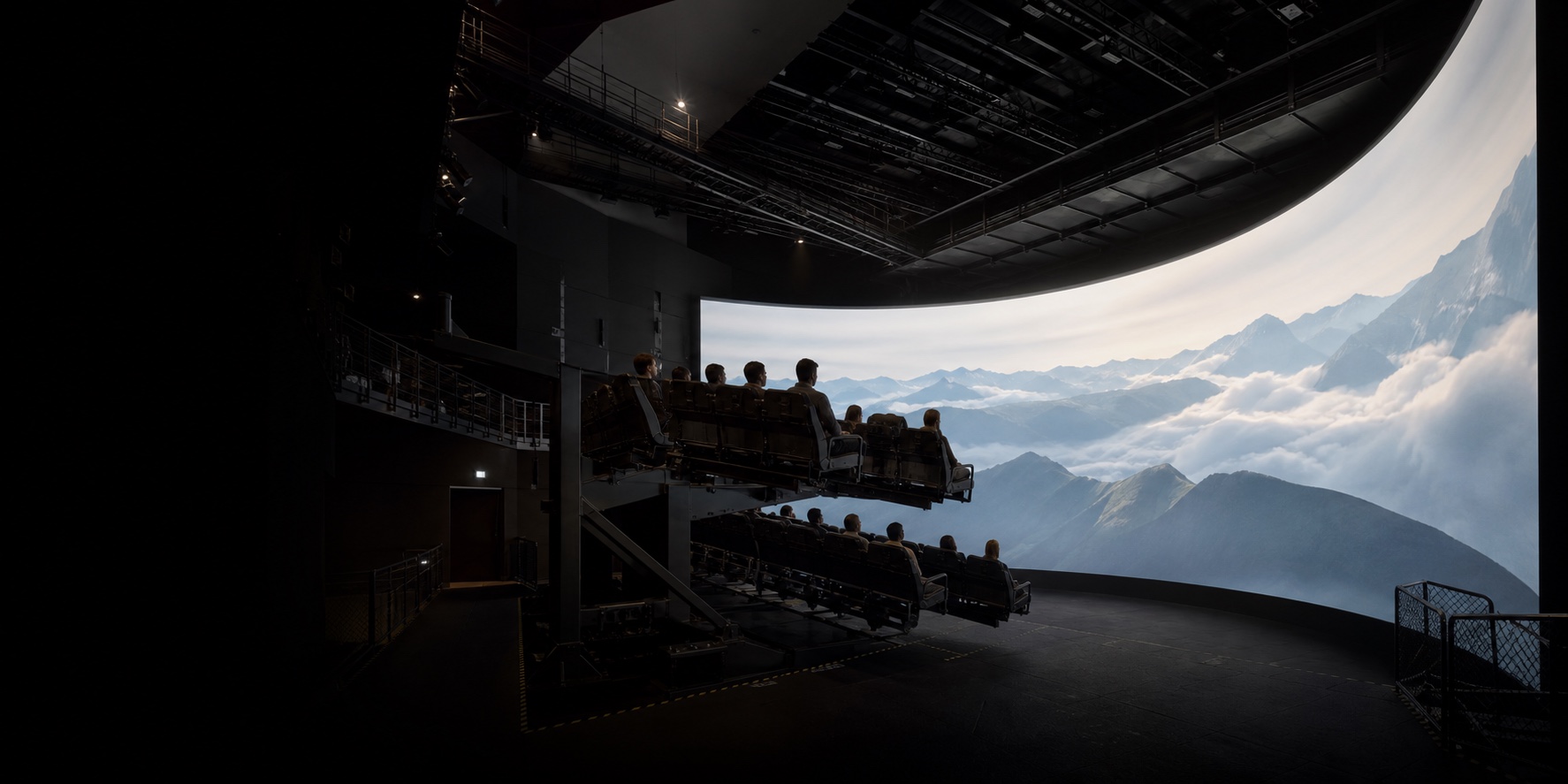
A flying theatre is one coordinated volume: moving passengers, an inward-facing image surface, structure, projection or LED, audio, effects, evacuation and maintenance. NJ Endure engineers the screen package around those interfaces.
A two-ended market
Large destination attractions compete on image quality, throughput and original content. Compact systems compete on footprint, repeatability and installation speed. Screen architecture must follow the business model and ride—not the other way around.
Passenger eye points, the swept motion envelope, emergency positions and rescue paths establish the no-conflict volume.
Capital cost, black level, heat, structural load, audio, maintenance and content pipeline are evaluated together.
Ride, screen, building, AV, audio, effects and egress share one datum and a controlled interface document.
Design freeze, factory pre-assembly, site access, third-party tests and ride commissioning are tied to the opening programme.
Venue format
The same screen language should not be applied to a 72-seat destination ride and a 10-seat museum installation.
| Planning area | Flagship flying theatre | Compact / modular flying theatre |
|---|---|---|
| Typical objective | Destination attraction, regional landmark, high throughput and proprietary film. | Add-on attraction for museums, malls, zoos, aquariums or smaller parks. |
| Display | Large cropped dome; high-end projection remains active, while premium projects may select LED. | Quarter dome or compact curved display, projection or LED depending on viewing distance. |
| Building | Dedicated volume, substantial height, ride pits/structures and complex egress. | Reduced footprint and height; modular or relocatable concepts can be considered. |
| Commercial model | High CAPEX, ticketed destination, long development and content cycle. | Lower entry point, revenue share or operator-funded models, faster replication. |
| NJ route | Full project-specific screen, structure, interface, installation and acceptance scope. | Standardised input/interface pack and partner-supplied ride/display system. |
Destination attraction, regional landmark, high throughput and proprietary film.
Add-on attraction for museums, malls, zoos, aquariums or smaller parks.
Large cropped dome; high-end projection remains active, while premium projects may select LED.
Quarter dome or compact curved display, projection or LED depending on viewing distance.
Dedicated volume, substantial height, ride pits/structures and complex egress.
Reduced footprint and height; modular or relocatable concepts can be considered.
High CAPEX, ticketed destination, long development and content cycle.
Lower entry point, revenue share or operator-funded models, faster replication.
Full project-specific screen, structure, interface, installation and acceptance scope.
Standardised input/interface pack and partner-supplied ride/display system.
Interface engineering
The screen cannot be accepted independently if a later ride, projector, effects or building change makes it unsafe or visually incomplete.
Static and moving eye points, swept envelope, field of view, safe clearances and visible edges.
Diameter, centre, tilt, crop and surface choice for perforated aluminium projection or partner LED.
Loads, supports, movement joints, access openings, fire strategy and local engineering interfaces.
Projector light paths or pixel map, loudspeakers, lighting, wind, mist, water and scent equipment.
Emergency states, restraint release, rescue access, walkways, fall protection and inspection zones.
Survey datum, factory trial fit, installation sequence, ride/display integration and measured acceptance.
Project sequence
A controlled design sequence protects the opening date and keeps changes visible to every responsible party.
Capacity, audience, content, ride type, display route, effects and operating model.
Overlay ride motion, eye points, screen, structure, building, AV and evacuation.
Issue the ICD, loads, datums, access requirements and controlled assumptions.
Manufacture, identify, trial-fit, inspect and package to the site installation sequence.
Install, survey, commission with ride/content/effects and deliver handover records.
Early project input
Send what exists. We can build an assumption register and identify which inputs must be frozen before budget or geometry can be committed.
Share the room and ride information. We will identify a feasible display geometry, the key interfaces and the decisions that control budget and programme.
Discuss a flying theatre →