Projection Dome Market Signals in 2025–2026: New Build, Digital Upgrades and Repanelling
LED domes are receiving attention, but public evidence also shows continuing procurement for new perforated aluminium domes, laser upgrades and lifecycle work. The market is best read as a sequence of project triggers—not a single growth percentage.
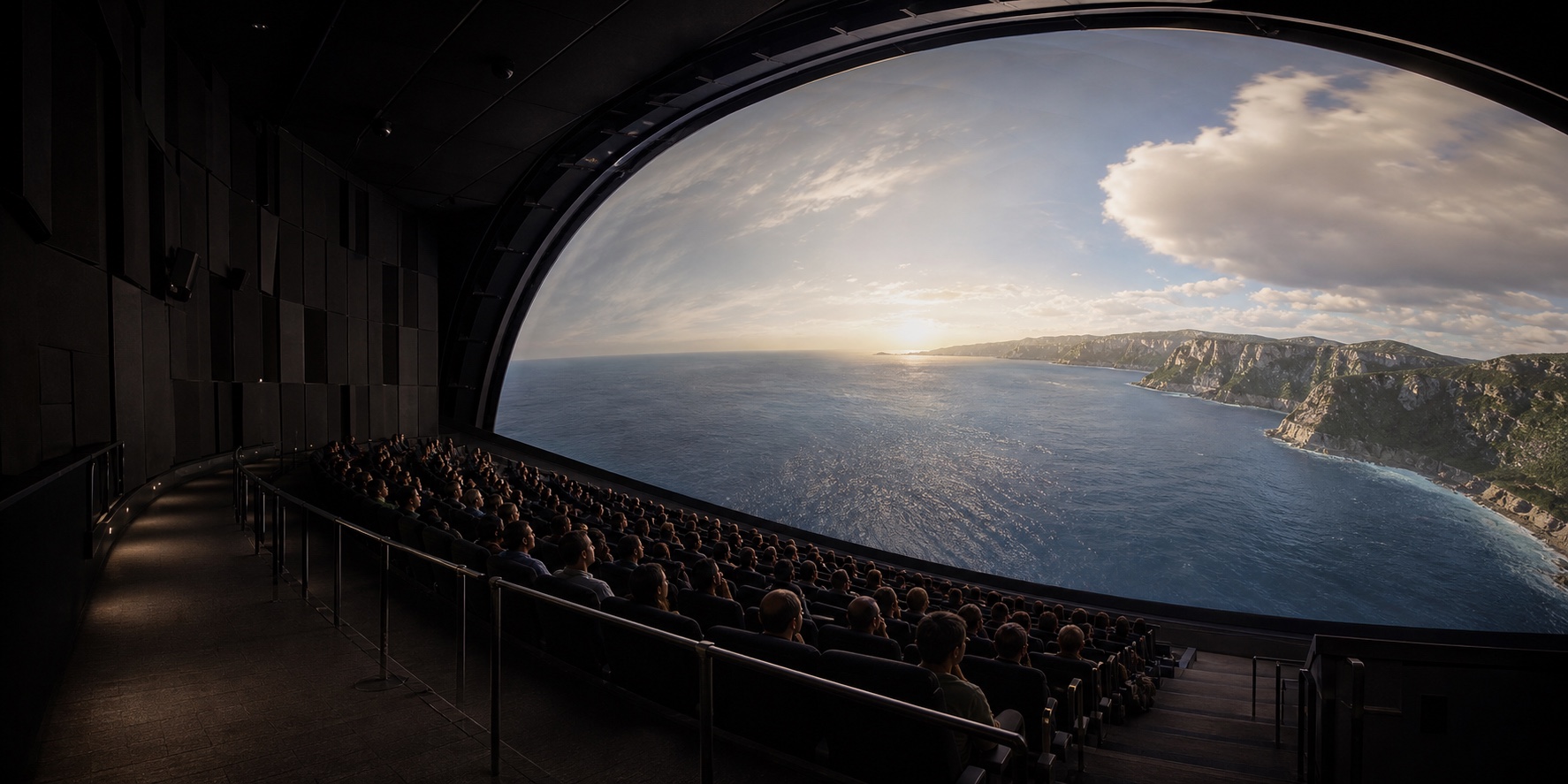
Editorial note. This analysis separates owner or procurement records, supplier statements and interpretation. Third-party projects are market evidence, not NJ Endure references.
The public conversation around immersive domes has shifted toward direct-view LED. That shift is real, but it can obscure a second reality: projection-based domes are still being built, digitised, repanelled and maintained.
The reliable way to read this specialised market is not through a generic “immersive display” CAGR. It is through visible project events: tenders, capital campaigns, closures, projection upgrades, acoustic renovations and screen replacements. This analysis reviews those signals as of 12 August 2026.
Five current signals from public projects
The following records are useful because they expose different parts of the buying cycle. They are examples, not a statistically complete global sample.
| Venue or procurement | Publicly visible signal | Market reading | Evidence limitation |
|---|---|---|---|
| Jackson Planetarium, USA | 2025 manual specifies a new 16 m, 180-degree perforated aluminium dome and support system | Full surface-and-structure renewal remains a separately specifiable package | Published specification does not reveal the final contract value or supplier outcome |
| Shimla, India | 8 m horizontal perforated aluminium dome tender | Small and mid-sized new-build science venues remain active | Tender issue is not the same as completed installation |
| Dehradun, India | 2026 tender for an 18 m, 18-degree tilted dome and 6K-plus active-3D system | Emerging public-science investment includes large projection theatres | Listing data require confirmation against final award and commissioning records |
| Orlando Science Center, USA | 2026 reporting describes a new perforated aluminium dome with 8K projection and behind-screen audio | Mature venues are replacing physical surfaces alongside digital upgrades | Current detailed reporting is secondary; final owner close-out data should supersede it |
| Science City Kolkata, India | 2025 procurement for an RGB pure-laser fulldome system in a 23 m venue | Projection upgrades can extend the useful life of very large domes | System tender does not by itself prove that the screen was replaced |
Primary documents are available for Jackson, Shimla and Kolkata. A 2026 procurement listing identifies the Dehradun scope. Local reporting on Orlando’s renovation describes the physical screen and planned opening; it should be treated as a provisional source until fuller owner documentation is published.
The installed base is the more important denominator
New-build counts alone understate the addressable work. The Worldwide Planetariums Database showed 2,818 fixed facilities on 12 August 2026. The database also contains mobile, old and closed entries, and it does not certify screen material. Its value is as a lead universe: each fixed venue has an age, projection history, seating plan, surface condition and capital cycle that can be investigated.
Long-term supplier disclosures point in the same direction. Spitz reports more than 2,000 dome installations, including more than 1,000 planetariums and nearly 100 giant-dome screens; it separately reports more than 250 NanoSeam installations since 2007. These are un-audited supplier totals spanning multiple decades, not a current market-share calculation. They nevertheless show why refurbishment can be as strategically important as new construction.
For giant dome cinema, the Fulldome Database estimates that roughly 125 venues remain in operation. The count is small, but each surface may be 20–30 m in diameter, making individual replacement programmes consequential.
Demand is activated by six project triggers
1. Projection and media-server renewal
New laser projectors, higher resolution and higher contrast can reveal conditions that older systems concealed: seam shadow, panel-to-panel coating variation, dust patterns and geometry error. A projection tender may therefore be an earlier screen opportunity than a screen tender.
The scope can range from a survey and cleaning to a new optical coating or complete repanelling. The correct intervention depends on measured surface condition, not simply age.
2. A venue changes purpose
Many domes now support more than astronomy. The International Planetarium Society notes the broad adoption of fulldome projection, while programmes such as Data to Dome connect live or scientific data to dome content.
Live presentation, films, concerts, corporate events and data visualisation introduce different priorities for brightness, reflectance, audio and sightlines. A venue conversion can therefore require surface and acoustic work even when the geometry remains unchanged.
3. Audio and HVAC are modernised
Perforations allow loudspeakers and air systems to operate behind the image plane, but the final result depends on the entire assembly: hole pattern, coating, speaker distance, backing material, cavity and equalisation. Upgrading to immersive audio can expose inaccessible speaker positions or a surface with excessive insertion loss.
This is a coordination opportunity, not proof that the screen alone is defective. The screen, audio, ventilation and maintenance route should be modelled together.
4. Surface condition becomes visible to audiences
Astro-Tec describes the “birdcage” pattern that can arise when dust darkens open areas while structure-shielded areas remain lighter. It also describes rear vacuuming, panel replacement and non-bridging recoating services. This is a supplier account, but it names observable maintenance problems that owners can inspect independently.
An unsuitable repaint can be equally damaging if it bridges perforations, changes reflectance unevenly or leaves spray bands. Acceptance should therefore include post-coating open-area checks and projected white/grey-field observation, not only a paint colour sample.
5. Building work creates access
The expensive part of a dome intervention is often not metal. It is closure time, floor protection, work platforms, scaffold, dust isolation, lifting and coordination with fixed seating. A broader building renovation can create a rare window in which repanelling becomes economical.
Spitz’s projection-dome FAQ gives a typical repanelling duration of seven to ten weeks, with roughly two weeks associated with platform and scaffold work and five to eight weeks for panel removal and replacement. Actual programmes depend on diameter, venue access, structure and finish, but the sequence explains why early scheduling matters.
6. LED enters feasibility review
LED does not need to win a project to affect the projection market. Once an owner compares direct-view LED with projection, the team must quantify structure, power, heat, audio, access, content and lifecycle costs. In some venues the result will favour LED; in others, repanelling plus a projection upgrade may preserve most of the desired experience at lower building impact.
The decision itself creates paid feasibility work. A technology-neutral consultant or screen engineering partner can establish the geometry and constraints before a display vendor is selected.
What current activity says about regional opportunity
Public procurement visibility makes India and parts of South Asia especially legible. Recent records span 8 m, 18 m and 23 m venues. The commercial barrier is not only price: local eligibility, bid security, long warranties, integrator relationships and service response are decisive.
North America has a mature installed base and visible renovation activity, but carries higher requirements for local engineering sign-off, liability insurance, site labour, safety management and references. For a new entrant, component supply, OEM work or a partnership with a local installer may be more realistic than an immediate turnkey promise.
Europe has established planetarium networks and strong incumbent relationships. Repanelling, non-standard museum surfaces and manufacturing partnerships can offer a more credible entry point than a direct replacement claim.
Middle Eastern projects frequently combine museums, tourism, themed entertainment and landmark architecture. Individual opportunities can be large but hidden inside experience-design or main-contractor packages. Early relationships with AV consultants and ride or exhibition integrators matter more than broad consumer marketing.
These are strategic interpretations based on visible procurement structures; they are not country-level market forecasts.
Why a precise global CAGR would be misleading
Several data problems prevent a defensible top-down growth rate:
- venue databases do not consistently record screen material, diameter, operating status or latest intervention;
- a “dome project” may mean a screen, projection system, complete theatre or building;
- supplier installation totals cross many decades and cannot be converted into annual demand without retirement data;
- private entertainment contracts are often confidential;
- public contract values frequently include audio, seating, content, building and AV services;
- one large 23 m project can distort a small annual sample.
A better commercial model is bottom-up:
qualified venues × intervention probability × addressable scope × win probability
The intervention probability should be driven by observable events—equipment age, closure, capital plan, tender, surface condition and partner access—rather than a generic industry percentage.
Projection and LED are likely to coexist
Direct-view LED offers compelling black level, contrast and freedom from projector shadows. It also introduces distributed heat, power, supporting mass, thousands of serviceable electronic units, content-mapping requirements and, for behind-screen audio, a specialised acoustic problem.
Projection retains advantages in very large area, lower surface mass, established fulldome content pipelines and mature acoustically transparent construction. It still faces cross-reflection, alignment, projector maintenance and shadow-management constraints.
The current evidence therefore points to segmentation, not immediate replacement:
- premium flagship venues may justify LED where the building and revenue model support it;
- large or budget-sensitive venues may retain projection;
- existing theatres may choose a projection and surface refresh to avoid structural and mechanical rebuilding;
- smaller experience spaces may choose either route based on viewing distance and operational use.
A disciplined way to monitor the market
A useful opportunity database should record, for each venue:
- owner, city, application and operating status;
- diameter, tilt, screen material and source confidence;
- projection or display system and last known upgrade date;
- surface, structure and audio condition if publicly documented;
- capital plan, procurement stage and target opening;
- consultant, architect, integrator and incumbent supplier;
- local certification, insurance and installation requirements;
- the exact evidence URL, publication date and whether it is owner, tender, supplier or media reporting.
That system produces fewer but better leads. It also keeps public analysis honest: a completed competitor project remains market evidence unless NJ Endure’s own contract, scope and publication rights are verified.