Beyond Flying Theatres: Where Perforated Aluminium Projection Surfaces Are Used
Perforated aluminium is not a flying-theatre-only material. Its real market spans permanent venues that need compound curvature, concealed audio and services, dimensional stability and a maintainable projection surface.
Editorial note. This analysis separates owner or procurement records, supplier statements and interpretation. Third-party projects are market evidence, not NJ Endure references.
Perforated aluminium is often introduced through one visually dramatic application: the flying theatre. That is accurate, but incomplete. The material platform has a much broader role wherever a venue needs a large, permanent and precisely formed projection surface while keeping loudspeakers, ventilation and technical infrastructure out of the audience’s view.
This article maps the applications supported by public owner records, procurement documents and supplier disclosures. It does not estimate that every dome or curved screen is aluminium. Screen material is frequently omitted from public records, so geometry alone is not evidence.
Why this material persists
A projection surface in an immersive venue is not simply a white lining. It sits between several systems whose priorities conflict:
- the image system wants controlled reflectance, colour uniformity and a continuous geometry;
- the audio system wants acoustic transmission and predictable insertion loss;
- HVAC may need air to pass through the surface without visible staining or excessive noise;
- the supporting structure must maintain shape across hundreds of square metres;
- installation and maintenance teams need a surface that can be divided, transported, aligned, repaired and refinished.
Perforated aluminium can balance those requirements. The International Planetarium Society’s theatre configuration guide describes perforated aluminium as the prevalent surface in modern planetarium domes and discusses a typical open area around 22%. That figure is a design reference, not a universal specification. Hole diameter, pitch, coating, reflectance and seam treatment must still be resolved for each viewing distance and optical system.
The useful market boundary is therefore not “all domes”. It is closer to permanent, engineered projection surfaces where geometry, acoustics and hidden services must work together.
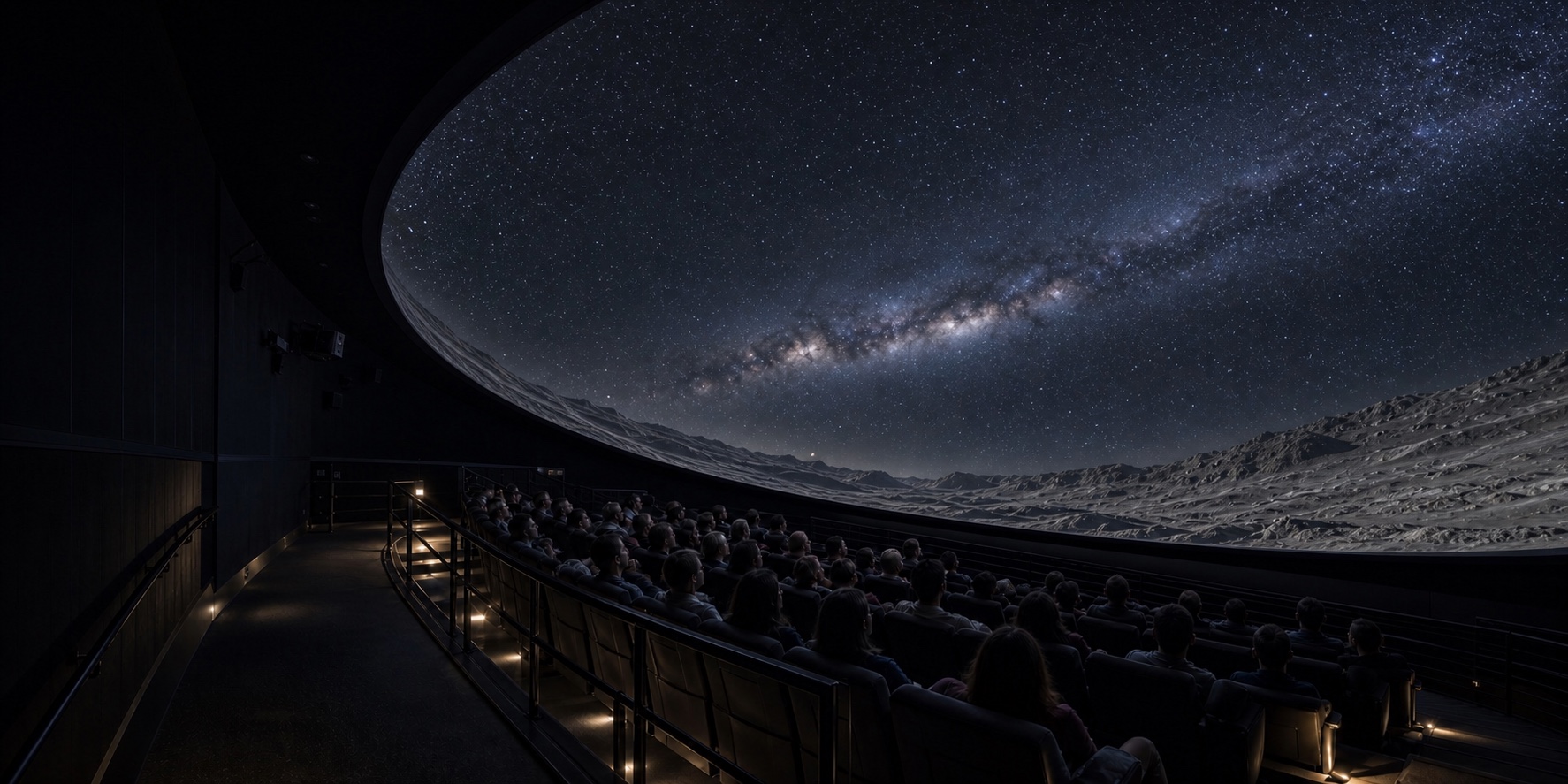
1. Planetariums and science domes
Fixed planetariums are the clearest installed-base market. The Worldwide Planetariums Database listed 2,818 fixed facilities on 12 August 2026, alongside mobile and old or closed records. This is a venue census, not an aluminium-screen count, but it provides a large pool of buildings that eventually require inspection, projection upgrades, cleaning, recoating or repanelling.
Planetarium requirements vary more than the familiar hemisphere suggests. A dome may be horizontal or tilted; fully hemispherical or truncated; concentric or directional in seating layout. A small education theatre may prioritise star-field contrast and close viewing. A large science-centre dome may also host films, live data, music and events.
Recent public procurement confirms that projection domes remain active infrastructure:
| Public project signal | Geometry and scope disclosed | What it indicates |
|---|---|---|
| Jackson, Mississippi, 2025 | 16 m, 180-degree dome; perforated aluminium surface and new support system | A complete screen-and-structure replacement can be procured separately from the broader venue experience |
| Shimla, India, 2024–2025 | 8 m horizontal perforated aluminium dome | Small and mid-sized public science venues continue to specify new rigid projection surfaces |
| Dehradun, India, 2026 | 18 m tilted dome with 6K-plus active-3D projection scope | Large projection-based public venues continue to enter the tender market |
| Kolkata, India, 2025 | 23 m dome receiving an RGB pure-laser system upgrade | Projection renewal can create a surface-assessment opportunity even when the dome is retained |
The first two specifications are available in the Jackson Planetarium project manual and the Shimla tender documents. Dehradun appears in a 2026 procurement listing, while India’s National Council of Science Museums publishes the Kolkata digital-system tender.
These are demand signals, not a global annual run rate. Public tender visibility differs sharply by country, and many projects are bundled into an AV integrator’s contract.
2. Giant dome cinema
Giant dome cinema is smaller in project count but much larger in surface area and integration risk. The Fulldome Database describes roughly 125 giant-screen dome cinemas still in operation. Some are traditional film domes, some have converted to digital systems, and their screen materials and operating status require venue-by-venue verification.
At this scale, cross-reflection, structural weight, access and installation sequencing become dominant. Reflectance that is useful in a compact planetarium can wash out shadows when bright image content illuminates another part of a highly enclosing dome. The screen may also sit above steep seating and close to large audio arrays, making scaffolding and repanelling a major part of the cost.
Owner evidence illustrates the system nature of these venues. McWane Science Center describes a 79 ft (24.1 m) tilted dome and 250-seat theatre. Liberty Science Center’s 2017 owner release describes a 27 m dome made from 588 perforated aluminium panels. These projects should not be read as a standard bill of materials; they demonstrate how quickly panel count, acoustics, projection and audience geometry become interdependent at giant-dome scale.
3. Museums, zoos and narrative science spaces
Not every dome is used for astronomy. Natural history, ecology, military history and location-based storytelling use the same ability to remove the rectangular edge of a conventional screen.
Two useful examples show the range:
- The Indianapolis Zoo project described by The Elumenati uses a 10 m truncated perforated aluminium dome. Truncation reduced the projected area and blending burden while preserving an enveloping field of view.
- A project report for the National Military Museum in the Netherlands describes a 14 m steel structure with floor-to-ceiling perforated aluminium, nine projectors and behind-screen audio.
The strategic distinction is important: these buyers may never search for a “planetarium dome”. They commission an immersive gallery, orientation theatre or interpretive environment. A screen supplier must therefore communicate in the vocabulary of architects, exhibition designers and AV consultants—geometry, access, acoustics, BIM interfaces and programme risk—not only diameter and gain.
4. Themed attractions and flying theatres
Flying theatres are a high-value subset because the moving audience, large field of view and hidden audio or special-effects systems place unusual demands on the projection surface. The geometry is normally a cropped or compound-curvature surface rather than a textbook hemisphere.
The screen cannot be designed in isolation. It depends on the complete eye-point cloud throughout the ride motion, the swept envelope of passengers and hardware, projector locations, emergency recovery positions, airflow, audio, water or wind effects, and maintenance access. A change of only a few hundred millimetres in the ride package can affect visible boundaries or projection shadows.
The same engineering logic extends to dark rides, 4D theatres, tunnels, cylindrical rooms and irregular media surfaces. Public project disclosures are less complete in themed entertainment because contracts are commonly private and protected by non-disclosure agreements. Supplier application statements, such as Endurescreens’ list of dome, flying-theatre, dark-ride, museum and tunnel uses, are helpful for mapping use cases but remain supplier claims rather than independent market counts.
5. Research and data visualisation
Immersive research facilities use curved surfaces for shared scientific exploration rather than ticketed entertainment. The UCSB AlloSphere is a prominent example: its official archive describes a three-storey instrument with two 5 m-radius hemispheres connected by a cylindrical section, supporting visualisation and spatial audio research.
This is a small and irregular market. Procurement cycles are long, and researchers may value optical calibration, multi-user viewpoints, sensor access or reconfigurability more than cinema convention. The opportunity is correspondingly engineering-heavy: scan-to-model workflows, unusual apertures, instrumentation mounts and documented surface tolerances can matter more than production volume.
6. Repanelling, cleaning and recoating
The installed base creates a second market that is easy to overlook. A mechanically sound frame may outlive its visible surface or the projection system it was designed around.
Spitz’s upgrade FAQ states that many existing structures can be repanelled with limited frame modification and gives a typical project duration of seven to ten weeks, including access-platform work. Astro-Tec’s service information describes rear-surface vacuuming, replacement of panels while retaining the frame, and recoating with non-bridging paint. Both are supplier descriptions, but together they identify a credible lifecycle category.
Typical triggers include:
- dust pulled into perforations, causing visible frame-shaped patterns;
- coating variation or blocked holes after an unsuitable repaint;
- projection upgrades that expose old seams or surface non-uniformity;
- a change in reflectance target, audio layout or ventilation strategy;
- local impact damage, corrosion or inaccessible services behind the screen.
This changes the commercial question from “How many new domes are built each year?” to “Which existing venues are approaching an AV or surface intervention?” Capital plans, temporary closures, projector tenders and seating renovations can all be earlier signals than a screen-specific tender.
What the evidence does—and does not—show
The evidence supports three conclusions.
First, perforated aluminium serves a portfolio of venue types, not one ride format. Second, the fixed planetarium and giant-dome installed base creates recurring assessment and renewal work. Third, the best opportunities frequently enter through an integrator, consultant or refurbishment programme rather than a direct request for a screen.
It does not support a precise global market-size or CAGR claim. Public databases mix venue status and technology; supplier totals cross decades and product categories; contract values often combine structure, screen, projection, audio and building work. A defensible market model therefore needs a bottom-up project census and a clearly stated scope.
A practical qualification checklist
Before treating a lead as a perforated-aluminium opportunity, establish:
- Is the surface permanent, and what geometry and audience eye points define it?
- Is screen material explicitly documented, or merely inferred from a photograph?
- Must audio, air or other effects pass through the surface?
- What are the closest viewing distance, pixel scale and seam-visibility target?
- Is the structure new, reusable or still unknown pending a survey?
- Who controls the specification: owner, architect, AV consultant, ride OEM or integrator?
- Are local structural certification, fire, seismic, insurance or labour requirements already assigned?
- What evidence is required at acceptance: geometry, reflectance, colour, acoustic loss, open area and visual seam inspection?
That checklist is more useful than classifying every curved venue as a dome-screen sale. It converts a broad material market into an engineering scope that can be evaluated, priced and verified.